
4 Strategies to Feel Less Busy and Take Back Power Over Your Schedule
I know what crazy busy feels like in my body.
It’s a kind of harried breathing—my attention darts from thing to thing.
It’s not realizing how bad I’ve had to pee—and for how long—because I’ve been so wrapped up in work, I forgot to get up, or to eat my lunch.
There are all kinds of reasons crazy busy happens.
Crazy busy happens because we work in a culture which focuses on long hours, rather than value being added.
It happens because (especially in design) we value butts in seats–both physically and digitally–and punish people for disconnecting, even if it leads to more productive outcomes.
Crazy busy happens because we live in a country that doesn’t have social support for parents.
But one of the reasons crazy busy happens—especially for women—is that we give away our power over and over.
And one of the main ways we do that is by giving away power over our time.
I joke that when I first started my women’s empowerment coaching, I thought my biggest obstacle to help women fight was patriarchy and sexism.
And then I learned that it was actually busyness.
[It’s one of the those funny “ha ha,” but actually true jokes.]
When I work with women, helping them craft their proactive career vision, I also assign them power habits.
Small habits, then can be used in the day-to-day to build power and confidence.
I do this because:
a) building up your confidence makes it easier to go get an ambitious career vision, once you’ve decided on it, and much more importantly.
b) it’s easier to let yourself dream up a more ambitious career vision when you’re experiencing the edge of what you thought you could do–and realizing that more is possible.
It became clear that taking back your schedule was one of the best ways to build your power and to practice setting boundaries.
So here are some of my favorite strategies to take back your time:
Strategy 1: Let Go of the Big List
I once interviewed Jean Carroon, a successful female principal at Goody Clancy, a Boston-based architecture firm. Jean sees women get stuck on their way up to leadership because they can’t transition from being a proficient, detail-oriented professional who gets everything done that they’re tasked with, to being a leader who makes the best choices she can, given limited resources.
“I never get everything done,” she told me, laughing. “The to-do list is never done. I’ve learned to live with that, and to thrive with that.”
“I see women who beat themselves up—who just can’t live with themselves when not everything is done. And it means they just can’t handle the next level of leadership.”
The Brass Tacks:
So how do you put this into action?
→ Move from the big list to just choosing the big ones.
The Pareto Principle, or the 80/20 rule is a concept from engineering that suggests that in any given system, 20% of the inputs, create 80% of the impact. In practice, 80% of the client referrals your firm gets probably come from 20% of its top clients. There are probably 20% of issues you pursue on your project that makes 80% of the impact for your clients and users.
And you can take this principle to your to-do list. Every day when you have the giant to-do list, circle the top 20% that will make the biggest difference to the high-level goals (ie. happy goals, on-time projects, cost savings) and tear into those. Let the other stuff fall away, or hand it off to someone else. You can even negotiate it away by telling your client or supervisor that spending time customizing the facade will pay off more than customizing the door schedules.
You will, in effect, be focusing on the things that make the biggest impact on the things that matter. And if you don’t dispatch everything on the list…
→ Forgive yourself when it doesn’t get done
Better yet, celebrate what did get done. And celebrate why you did it…
“So glad that I spent my day on this one proposal that we’re most likely to get rather than responding to those inquiries that are only so-so fits for us.”
Strategy 2: Align Your Time
Ever had a day when a lot of stuff gets done, but it felt like none of it really mattered? Or when you feel like everyone else’s stuff moved forward, but not yours?
One of the biggest places we give up control is our schedule. Early in our careers, our time is not ours. We usually have one to two people supervising us, who give us a schedule and timeline. We sit in our seats and get it done. Our time is theirs, in effect. Our schedules open, except for what they put on it.
But as we grow in our careers, and gain more autonomy, we don’t always apply our autonomy to our time. We end up with back-to-back meetings and no time to get deep serious work done; saying yes to commitments because we feel like we should, rather than figure out of a clear strategy. Our time isn’t aligned with when we are at our best for meetings, design work or proposal writing.
We get interrupted all day, every day, and don’t prioritize the things that really matter.

The Brass Tacks:
So what do you do about it?
→ Develop an ideal schedule
I’ve long been inspired by Racheal Cook’ model calendar. She has a system for plotting out what essential business functions she needs to get done onto an ideal week. But I’ve suggested this approach to women who I work with who are not business owners and they struggle. That on-site client meeting is on Thursday morning, and has been for the last two years. Your boss needs you, the model calendar goes out the window, and you just feel bad.
An ideal schedule is like the 80/20 rule of the model calendar. Instead of planning out your whole calendar, get clear on what important work looks like for you, and block out time to get it done. One of my students’ schedule was filling up with administrative work, and she wasn’t getting her big independent project done. She’d try to work in the mornings, but in her open-plan office, people would float in and chat. All the sudden, the morning, and then the day would be lost. She started blocking out two-hour chunks from 10 a.m. to 12 p.m. Tuesday through Thursday–(when all the chit-chat would die down)–to put on her headphones and get to the work that mattered. She blocked them out on her calendar and asked to schedule all non-essential meetings around those six hours.
In six hours a week, she was able to substantively push out her big project and get a promotion. She stopped waiting for a big chunk of time and realized she needed a chunk that was just big enough.
→ Hold “Office Hours”
Strategy 3: Say No (Without Sounding Like You Are)
Many of the women I work with manage others and struggle. They struggle for a whole host of reasons: they worry too much about being liked by their direct reports, worry that they are being a ‘bad boss,’ are micromanaging in their attempt to be a good boss, get assigned too much mentoring relative to men, and I could go on. But they also get interrupted by the people they manage all day every day. This means by the time they finally sit down to work, they are often interrupted again, and lose their concentration…. All over again. It’s common for them to plan to work after hours because it’s the only time they can focus.
I suggest they create office hours for their reports—say every day in the afternoon, or three times a week. If you want to get fancy, you can even provide open hours to anyone who needs it by using a free calendaring app such as youcanbook.me to facilitate sign ups, but only make certain hours available. In doing this, they benefit from what’s called batching in which you “batch” together similar tasks to benefit from concentrating on them all at a time, instead of switching from one thing to another, which takes more time than you think (It’s called “switching costs.”)
You save time, now and in the future, with people that are more independent. If you are only available to them three times a week, barring an emergency, you train them to think ahead about what questions they need answered to move forward with their work.
The Brass Tacks:
So what do you do about it?
→ Stop Stepping Into Office Housework
While it’s true that you may be being volunteered for office housework, and things that don’t push forward the goals you are working on, you also may be stepping into that role more than you think. I gave one woman I coached what I call “a no-diet.” I asked her to record in a journal, when she felt she was being given office housework, and to say no to something every day.
It turns out, she was actually volunteering for the work.
She’d somehow found a way to feel valued at the office by helping out everyone else. But it was burning her out and preventing her from stepping into the shoes of the role she’d just been promoted into. So she stopped.
Sometimes people won’t notice when you stop. Sometimes they will because you’ve caused them to rely on you. But take a page from my friend Lou. Early in her career she somehow got stuck in the role of always taking the meeting notes. That changed one day because of the advice of a woman in senior leadership. One day, when asked, as always at the beginning of the meeting, “‘Lou, you’ll take the notes?”’ she just said, “Sorry, I don’t have a pen.”
→ Say “Not Yet,” Or “I’d Love to, But…”
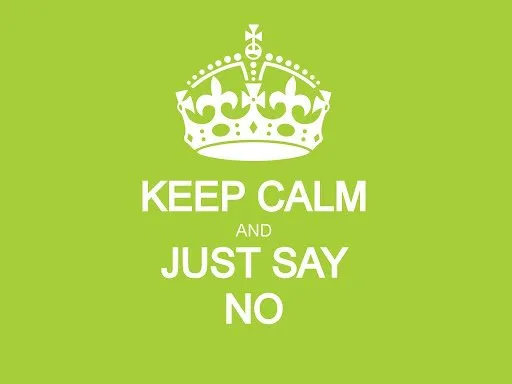
We don’t like women who say “no,” as I shared previously. But sometimes you can say “no,” without sounding like it.
I sometimes think of a friend of mine who got asked out by someone she wasn’t interested in romantically.
“How about dinner?” He’d ask.
“How about lunch?” She’d downgrade.
“How about drinks?” he’d say.
“How about coffee?” she’d counteroffer.
Now, let me just get clear—I don’t advocate for ever feeling like you can’t just say “no.” Your body, your time, your life.
But, I think it’s a hilarious story, and I also think that feeling women have—feeling guilty around disappointing men and not being able to say “no,” is at the root of why it’s so hard in other realms for so many women to say “no.”
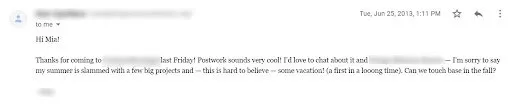
So here’s what you can do instead: Say no to say yes to something else. “I wish I could, but I have to help my team get the set out next week and need my full focus on that.” Or say “not yet.” “Sounds fantastic, but the next month my extra credit slot is taken up by finding Jim’s replacement. Reach out if it’s still at the top of your mind after then?”
You’ll be smiling and nodding, and so it will be a no that doesn’t feel like a no, which goes a long way in avoiding the pushback that “women who say no” face.
Strategy 4: Fill Your Time with Your “Yes.”
I found, through years of coaching and training, that it’s easier for women to say “no” when they’re saying “yes” to something else.
It’s easier for you to prioritize, to protect your time, when you know where you’re ultimately trying to go, and what you need to do to get there. This is why I work with women to craft North Star Visions: proactive plans for how they want to grow in their careers and businesses.
That vision takes up space and pushes out the things that don’t matter.
- So when you know that you’re trying to become a design principal, you’ll say “no” to the offer to be on the BIM standards committee.
- When you know you need to go to two networking breakfasts per month, it’s easy to coordinate with your partner to take over drop-off.
- When you know that your ideal client values employee engagement, you’ll know which slide of the presentation to spend the most time on.
The Brass Tacks:
So how do you put this into action?
→ Find Your North Star
My Creative Career Intensive program helps busy, ambitious women in design develop their proactive career visions. My five-step methodology is designed to help you look at what motivates you, map out what opportunities exist, and results in a clear career vision and roadmap for getting there.
→ Make a Date with Your Future
One of the first things I suggest women do is put time on their “ideal calendar” weekly (even if it’s only 20 minutes) to focus on where they would like to be in one to five years and to take action on getting there. Even if you don’t know, at first, what to do with that time, just showing up for your future to even think about what you might want it to be—or to read or learn—establishes a habit you can build on.
Better yet, do it with a friend. I have a ‘business wingwoman.’ We meet weekly, and have been for the past five years, to get out of the day-to-day and work on higher-level business issues. I also often pair up women who leave my programs with an accountability buddy from the Build Yourself Alumna community.
Want a helpful reminder to ensure you are taking back your time? Get my free checklist of the 4 strategies to feel less busy here.


