
Sending a promotion request letter or email can secretly sabotage your career advancement. This guide shows you three reasons why—and how to pitch your promotion live with confidence.
Why Promotion Request Letters Can Hurt Your Career Advancement
So you feel like it’s time for you to move up in your company, and you’re wondering how to ask for a promotion. Maybe you’ve seen other people get promoted over yo,u and you feel like it’s your time.
Maybe you feel like you’re being passed over and your strengths are not being seen. So you’re looking for a way to make the business case for promotion to your boss and demonstrate your readiness for the role.
Now you might be tempted to write a promotion request letter or an “asking for a promotion” email to make your pitch for your next role.
Maybe you even found a template to follow and you’ve already replaced the address block and “Dear Sir or Madam with your dear old supervisor’s details.
Stop right there!
Writing a letter to request a promotion or an “asking for promotion” email is one of the worst ways to actually get a promotion.
3 Reasons Why You Shouldn’t Write a Promotion Request Letter
Reason 1: A Promotion Request Letter Signals Avoidance and Lower Confidence
Writing a promotion request letter or an email when you could pick up the phone or have a conversation in person is an avoidance mechanism. Email is a place to hide.
I get it, email allows you to gather all your thoughts together and present your promotion pitch perfectly. But it’s also less direct and less brave.
And it creates cognitive dissonance for the boss reading your letter or email. You’re asking for more responsibility and leadership, but you are demonstrating that you can’t own your promotion request and do hard things like chance rejection, which is an essential leadership quality.
This is particularly important if you’re a woman or come from a background with fewer people in leadership positions. Initiating the conversation challenges the tendency some leaders have to overlook women, and positions you as growth-driven.
As Brene Brown says, “You can’t get to courage without rumbling through vulnerability.” And asking for what you want with your boss is good practice for asking for what your company needs, which will make you a better leader.

Asking for a promotion at work in person makes you look more powerful and confident – even if you feel like the opposite.
2. It’s Easier for Your Boss to Say No by Email
Another reason why you shouldn’t write a promotion request letter: If email is an avoidance mechanism for you, it’s also an avoidance mechanism for your boss when it comes to responding to your promotion pitch.
As listeners, we are in a different mental space when we read an email or a letter than when we are in a direct face-to-face or voice-to-voice conversation. Your boss may read your letter but never fully process it or be forced to focus on you solely and your request in an email.
When distracted, culling through their inbox, your boss may not fully consider your promotion pitch deeply. They may intend to think about it when they have more time… and they may never get back to you until you awkwardly check in…. “Hey, so about that promotion request letter I sent…?”
When you request a promotion live, you force your boss to pause and create mental space to truly consider your business case for promotion. You’re much more likely to have a substantive conversation about your promotion opportunities.
Want guidance and support in defining and pitching your promotion request? Apply to my career coaching program for women executives and mid-career professionals.
3. A Letter Shuts Down Collaboration and Feedback
One of my recent clients wanted to become a principal and owner in her firm. We created a specific promotion pitch. The next step was to talk to her leaders. She put it off for weeks. Having the conversation was intimidating. What if they said no?
But she finally had her first promotion conversation, and this is what happened: Her boss was excited for her and listened to the specific value she wanted to add to the leadership team.
Then her boss suggested an alternative role that was even a better fit for what the firm needed—and also a better fit for her strengths and interests.
When you have a live conversation, you can work collaboratively with your boss to define a way forward—and you’ll get access to insight on what the business needs and how decisions are truly made. This can lead to an even better promotion for you and provide key insights into navigating the “unwritten rules” of how the company promotes people.
This can result in an even better promotion for you and provide key intelligence on navigating the “unwritten rules” of how the company promotes people.
Even if your promotion request doesn’t go as well as my client’s did, it can still be immensely helpful. You might find that you have a key qualification that’s missing, and you can ask how to fix it. You might find that the business strategy is changing, which could lead you to advocate for a different promotion.
These are not outcomes that happen from a rigid promotion request email.
And if they say no, you can actually ask why and decide how you want to move forward.
Even though email is one of the most dominant ways of communicating at work these days, if you want candid feedback and back-and-forth dialogue, you can’t get it through an email exchange.
How to Ask for a Promotion, the Brave (and Effective) Way
I get it. The reason you want to send a promotion request letter or “asking for a promotion” email is that you can make the business case for promotion perfectly, and your nerves won’t affect your delivery of the promotion pitch.
But because of the downsides, here’s the promotion pitch process I recommend instead. It’s the perfect combination of directly making your promotion pitch live, with the benefits of preparation and structure that come with a promotion request letter or email.
Step 1: Don’t Bring a Letter—Bring a Prop
I recommend that my clients break down the job description for the promotion that they want and list their qualifications, as well as their relevant experience, for each qualification.
It gives you and your boss something to discuss and shows that you have already done independent, serious thinking about what the promotion would entail.
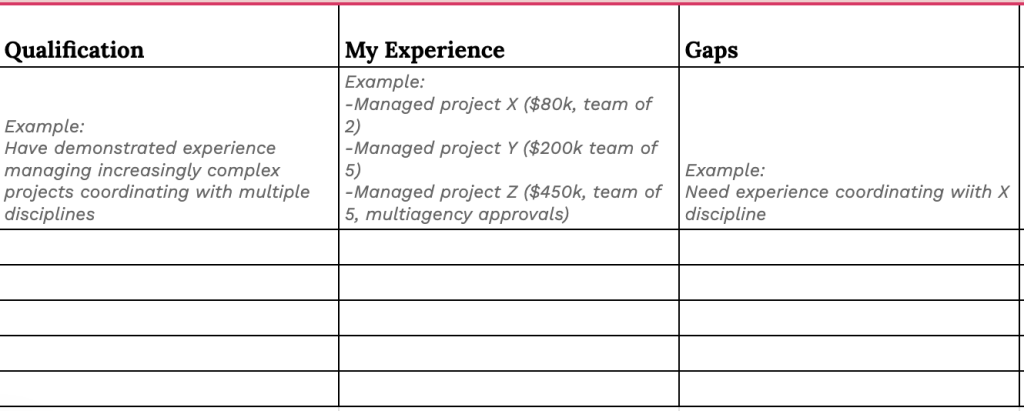
There’s a lot of prep work you can do in advance of asking for a promotion to build the case for your promotion. Comparing your qualifications to the job you want will help you understand exactly what to focus on.
I give my clients a Promotion Request Tool and Tracker to bring to their conversation with their bosses, and it focuses the promotion pitch conversation without becoming a tool that you hide behind.
Step 2: Role-Play to Build Confidence Before the Real Pitch
Get a family member or friend to sit down with you for 10 minutes and pretend that they are your boss, fielding your promotion request. Bring your Promotion Request Tool and Tracker. Walk them through it as if they were your boss.
Have them play the role of your boss, responding respectfully but also asking questions that you need to respond to.
When you do this in advance of your promotion request conversation, you’ll build a “body memory” of having the big scary conversation before you have the real one. You’ll be more familiar with how to phrase the business case for promotion and respond to any challenges.
Don’t have somebody you can role-play with? Book a call with us and we’ll show you how we can help. Click here to find a time that works for you. Get a family member or friend to sit down with you for 10 minutes and pretend that they are your boss, fielding your promotion request. Bring your Promotion Request Tool and Tracker. Walk them through it as if they were your boss.
Have them play the role of your boss, responding respectfully but also asking questions that you need to respond to.
When you do this in advance of your promotion request conversation, you’ll build a “body memory“ of having the big scary conversation before you have the real one. You’ll be more familiar with how to phrase the business case for promotion and respond to any challenges. You’ll be more confident when presenting your promotion pitch and will feel less nervous.
Step 3: Treat Every Promotion Conversation as the First of Many
Remember that usually it takes several conversations to get a promotion at work. Sometimes your first pitch doesn’t land, or it’s just not the right time.
In the Promotion Request Tool and Tracker I give my clients, there’s a status column that my clients use to report back to their bosses on any last qualifications or experiences they need to fulfill to be ready for promotion. This reduces a boss’s tendency to say, “You’re not ready yet,” without giving you specific reasons why.
Even if your promotion pitch is declined, that doesn’t mean there isn’t massive value in starting the conversation.
So don’t get discouraged if the first conversation doesn’t get you the promotion you want. Keep at it!
You don’t want to go through all the work of putting a promotion request letter or an “asking for a promotion” email together only to get a big “no” that you could’ve avoided.
Use this process instead. Not only will you increase the chances of getting a yes to your promotion pitch, but you’ll also build your strength, leadership, and confidence in pursuing your dream promotion.

